
Beyond Budgets
The Real Cost of Cost Overruns

The Persistent Problem
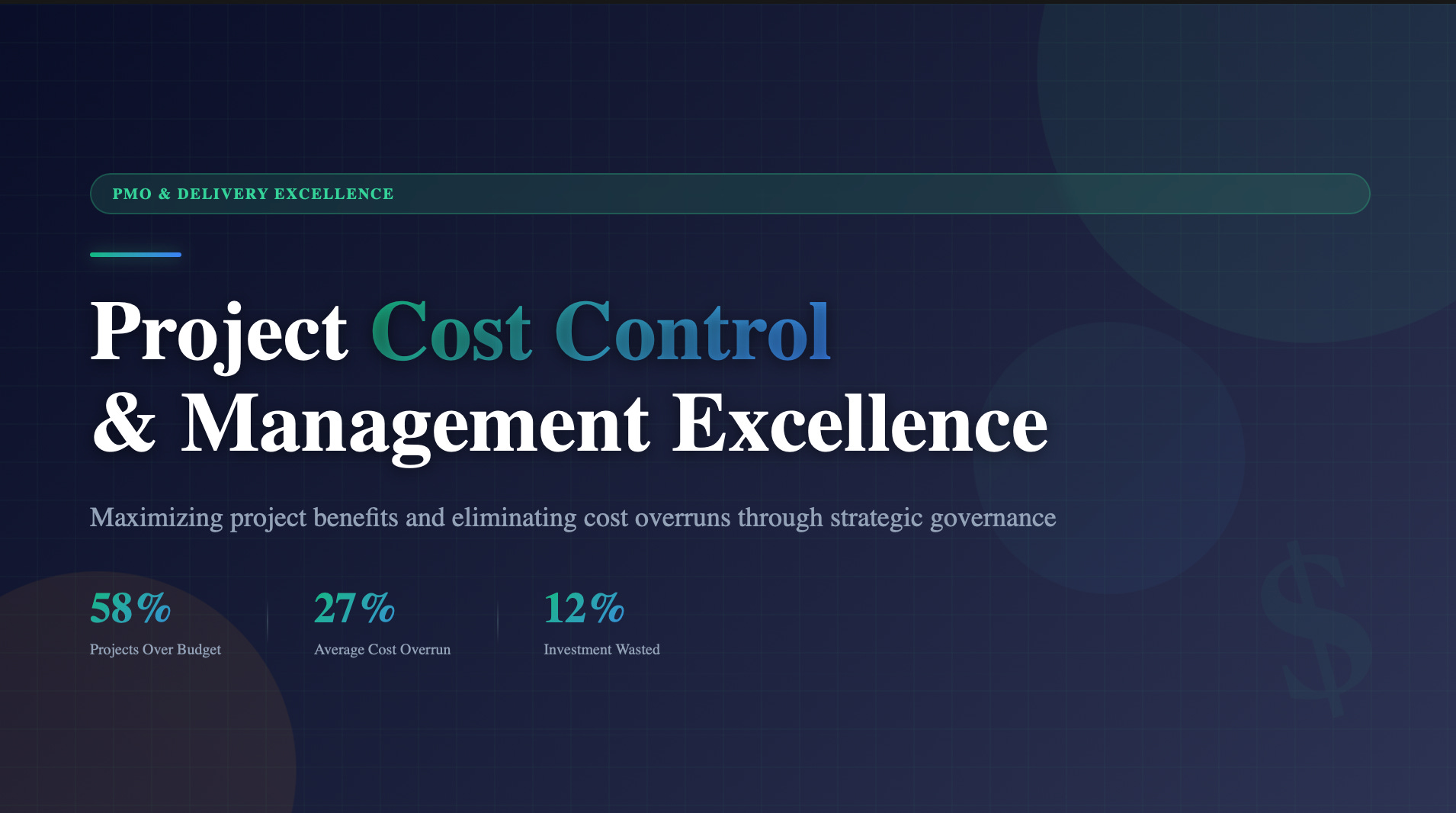
After decades of advances in project management methodology, here’s the uncomfortable truth: studies show that 58% of projects still experience cost overruns, with the average overrun at 27%. But what keeps executives awake is not the budget breach but the strategic opportunity cost.
Every dollar over budget is a dollar not invested in innovation, market expansion, or competitive advantage. The real question isn’t “Why did we overspend?” It’s “What strategic value did we sacrifice?”
Why “On-Budget” Isn’t Good Enough
Traditional cost management tracks actuals against baseline. Mature cost governance asks a different question: “Are we maximizing value per dollar invested?”
Consider two scenarios:
Project A: Delivers 100% of scope, 10% over budget, captures 90% of projected benefits Project B: Delivers 85% of scope, exactly on budget, captures 100% of projected benefits plus identifies $2M in additional savings
Which succeeded? Most governance frameworks would flag Project A as failing. Yet Project B delivered superior business outcomes by making strategic trade-offs between scope and value.
The Five Hidden Drivers of Cost Overruns
Most cost overruns don’t happen because of poor estimation, they happen because of governance blind spots:
1. Scope Creep Disguised as Clarification “We’re not changing scope, just clarifying requirements” is the most expensive lie in project management. Every clarification that adds work is a scope change. Govern it accordingly.
2. The Sunk Cost Trap “We’ve already invested $5M, we can’t stop now” ignores that the next $5M might deliver zero incremental value. Build kill criteria into your governance framework and use them.
3. Resource Cost Invisibility Your project shows green on budget because you’re not tracking the $500K in “borrowed” resources from operations. Fully loaded costs tell the real story.
4. Integration Complexity Underestimation The individual components cost exactly what you estimated. The integration effort cost 3x projections. This pattern repeats because integration complexity isn’t estimated, it’s hoped for.
5. Benefits Erosion Through Delay A project that’s on-budget but six months late has lost half its NPV in many cases. Time is cost. Govern accordingly.
Three Questions to Transform Cost Governance
1. “What’s our cost of delay?”
Calculate the weekly value loss from schedule delays. Make this visible in every governance review. When teams understand that a two-week delay costs $200K in deferred benefits, priorities clarify instantly.
2. “Which scope delivers disproportionate value?”
Not all scope is equal. Identify the 20% of scope that delivers 80% of value. Protect this ruthlessly. Everything else is negotiable when cost pressures emerge.
3. “What’s our value per dollar trending?”
Track benefit realization divided by actual cost spent. If this ratio is declining, you’re spending more to deliver less value. This signals the need for fundamental reassessment, not just budget adjustments.
The One Change to Make
Implement Value-Based Cost Reviews
Traditional cost reviews ask: “Why did we spend $X more than planned?”
Value-based reviews ask: “For the $X we spent, what value did we create? Is our value-per-dollar improving or declining? Where should we spend the next dollar for maximum return?”
This simple re-frame transforms cost control from a compliance exercise into strategic value optimization.
The Governance Framework That Works
Effective cost governance operates at three levels:
Strategic: Quarterly reviews assessing whether continued investment makes sense given current costs, projected benefits, and strategic context. Be willing to redirect funds to higher-value opportunities.
Tactical: Monthly reviews of cost trends, burn rate, and value-per-dollar metrics. Focus on leading indicators; commitments made, not just invoices paid.
Operational: Weekly tracking of actuals vs. forecast with immediate escalation of variances above defined thresholds. Speed matters; a cost issue identified today is manageable; the same issue discovered in three months is a crisis.
The Real Success Metric
A project that stays perfectly on budget but delivers mediocre business outcomes has failed strategically. Conversely, a project that exceeds budget by 15% while delivering 200% of projected value has succeeded. Perfect cost control that delivers mediocre business value is strategic failure. Your goal isn't zero cost variance but it's optimizing return on every dollar invested.
Sometimes the right decision is spending more to capture disproportionate value. Sometimes it’s spending less and accepting reduced scope. The key is making these trade-offs explicitly, based on value analysis, not letting them happen by default.
Your PMO should enable the organization to answer: “Are we spending wisely, not just spending as planned?”
#cost_control #project_value #cost_governance #strategic_value #cost_overruns